What Is an Offshore Development Center? A Guide for US Companies
Accelerate your global growth with Kaamwork's streamlined offshore development centers. Build high-quality teams fast, cost-effectively, and compliant — start today!

ByNilesh Parwani / October 24, 2025 / 4 min read

An offshore development center (ODC) is a dedicated team of engineers in another country, usually India, that works only for you. A partner handles hiring, payroll, space and compliance, so you build a team without setting up a local entity.
For US companies, an offshore development center in India is one of the fastest ways to add engineering capacity without opening a legal entity first. This guide explains how an ODC works, which model to pick, what it costs and where the risks sit. If you want the ready-made version, see our offshore development center solution for India.
An ODC is a good fit if:
- You need five or more engineers on a long-term roadmap, not a one-off project
- You want to manage the team directly, as you would an in-house team
- You want to test India before committing to a subsidiary
How does an offshore development center work?
An ODC sits in India but works as an extension of your US engineering group. You choose the roles, interview the candidates, set the roadmap and run the stand-ups. The ODC partner provides the legal and operational base: employment contracts, payroll, statutory benefits, office or co-working space, laptops and HR support.
The process has three parts. First, you define the roles, seniority and tech stack. Second, the partner recruits, or you recruit and the partner employs. Third, the team ramps up on your tools, your code repositories and your processes. You own the code and the product decisions; the partner owns the employment relationship.
This is what separates an ODC from outsourcing. An outsourced vendor owns delivery and shares a team across clients. In an ODC, the team is dedicated to you and takes direction from you.
ODC models: which one fits?
Dedicated team through a partner. The partner employs the engineers and charges a monthly fee per person. You direct the work. This is the fastest model to launch and the easiest to scale down if plans change. Most companies building their first offshore development team start here.
EOR-backed ODC. You recruit the people yourself, and an employer of record becomes their legal employer in India. You keep full control of who joins and pay salary plus a service fee. It suits companies with a strong recruiting pipeline who do not want a partner choosing the team.
Build-operate-transfer (BOT). A partner builds and runs the center for a fixed period, often two to three years, then transfers it to you as your own Indian entity. It suits companies that know they want a permanent presence, but it needs the longest commitment.
ODC vs GCC vs staff augmentation vs EOR
These four terms are often confused. The main differences are who employs the team, how much control you get and whether you need your own entity.
ODC | GCC (captive center) | Staff augmentation | EOR | |
|---|---|---|---|---|
Who employs the team | Partner or EOR | You, through your Indian entity | Staffing vendor | EOR |
Your control | High | Full | Medium | High |
Indian entity needed | No | Yes | No | No |
Setup time | [weeks, from your data] | Months | Days to weeks | Days to weeks |
Cost model | Monthly fee per person | Entity, office and payroll costs | Hourly or monthly rate | Salary plus service fee |
Best for | Long-term teams of 5 or more | 50 or more people, permanent presence | Short projects, quick fills | Hiring individuals |
A GCC (global capability center) is a company-owned center in India. It gives you the most control and the highest upfront cost. Many companies start with an ODC and convert to a GCC when headcount justifies it. If you are weighing EOR against PEO along the way, read EOR vs PEO in India.
What does an offshore development company charge?
An offshore development company or ODC partner usually charges in one of two ways. The first is a fixed monthly fee per person that bundles salary, benefits, space and overhead. The second is salary at cost plus a fixed management fee. The fixed fee is easier to budget; the cost-plus model is more transparent.
What drives the number is role, seniority, location within India and team size. Senior engineers in Bengaluru or Hyderabad cost more than mid-level engineers in smaller cities. Ask any partner for a full breakdown: salary, statutory contributions, space, equipment, recruiting fee and management fee.
Use our global cost calculator to estimate cost for your roles.
Risks to plan for
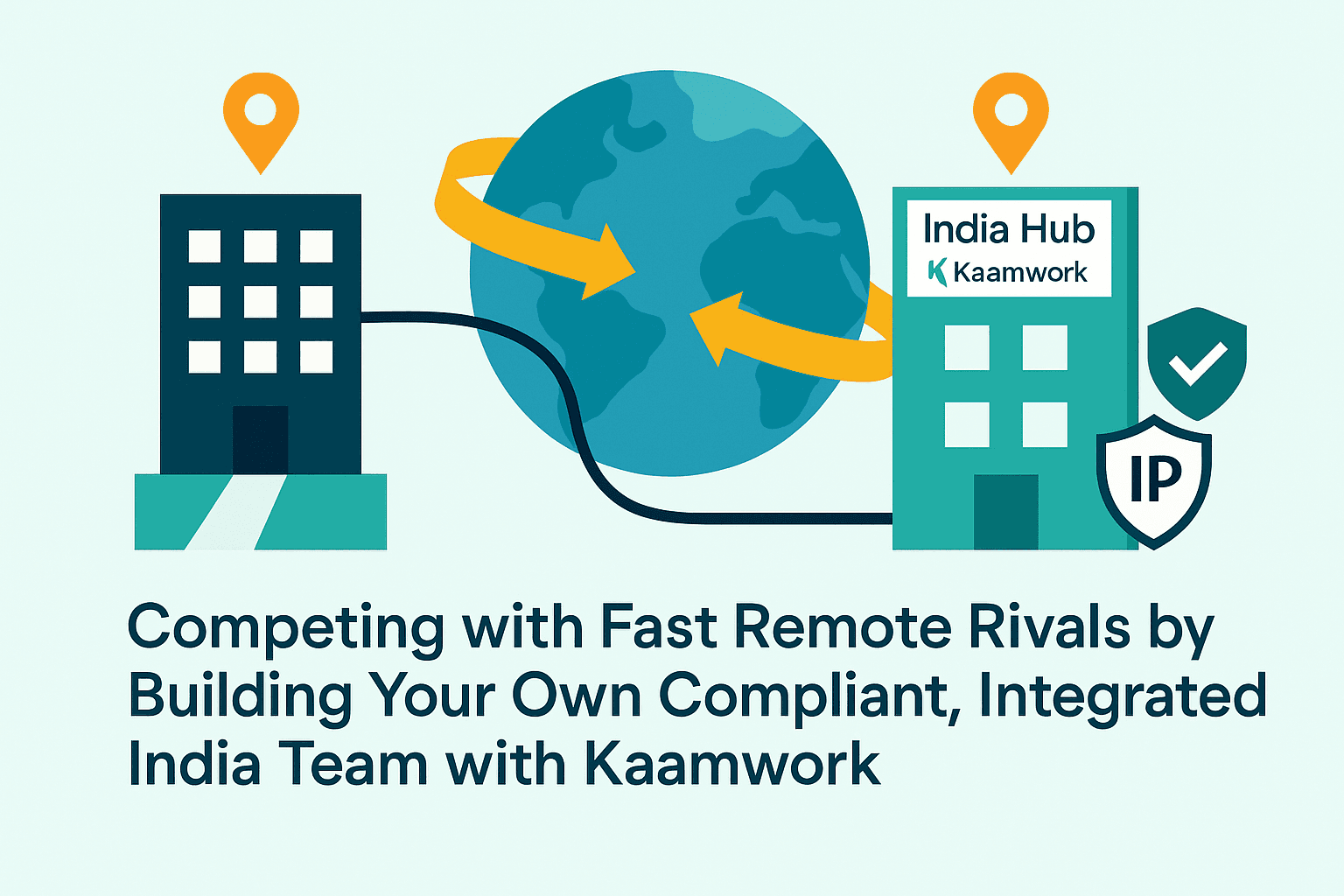
Permanent establishment. An offshore team can create a taxable presence for your US company if managers in India sign contracts on its behalf or if you control the office space. Read our guide to permanent establishment risk in India.
IP ownership. Employment contracts should assign all work product to your company. Confirm this in writing before the first hire starts.
Attrition. Engineer turnover in India can be high. Ask the partner for retention figures, a replacement guarantee and a notice-period policy.
Vendor lock-in. Make sure the contract lets you hire the team directly, or move to your own entity, with a defined transfer fee.
How to set up an ODC in India
- Define roles, team size, budget and the first six months of work
- Choose a model: dedicated team, EOR-backed or BOT
- Shortlist partners and compare contracts, IP terms, transfer terms and references
- Hire the first two or three engineers and test the working model for 60 to 90 days
- Scale in steps and review quality, cost and retention every quarter
- Decide whether to stay on the partner model or convert to your own entity
If you later add contractors alongside the ODC, see how to hire contractors in India without misclassification risk, and keep in mind the employer of record service option for individual hires.
FAQ
- What is an offshore development center?
A dedicated team in another country, usually India, that works only for your company while a partner handles employment and operations. - ODC vs GCC: what is the difference?
An ODC runs through a partner and needs no entity of your own. A GCC is a captive center you own through an Indian subsidiary, which gives full control but takes longer and costs more to start. - How much does an offshore development center in India cost?
It depends on roles, seniority and team size. Costs are usually a monthly per-person fee or salary plus a service fee. Use the cost calculator for an estimate. - How long does it take to set up an ODC?
Starting through a partner is much faster than opening your own entity. - Do I need an Indian entity to run an ODC?
No. A partner or an employer of record can be the legal employer. - Does an ODC create permanent establishment risk?
It can if it is set up carelessly. Keep contract authority and management decisions in the US and use partner-owned space.
Ready to build your team? Talk to Kaamwork.
Share this article

Founder & CEO | Kaam.Work
Nilesh Parwani, a Kelley School BBA graduate, worked at UBS and Warburg Pincus before founding PrintBell (acquired by Cimpress). In 2020, he launched kaam.work, a remote work platform focused on flexible talent and distributed teams.