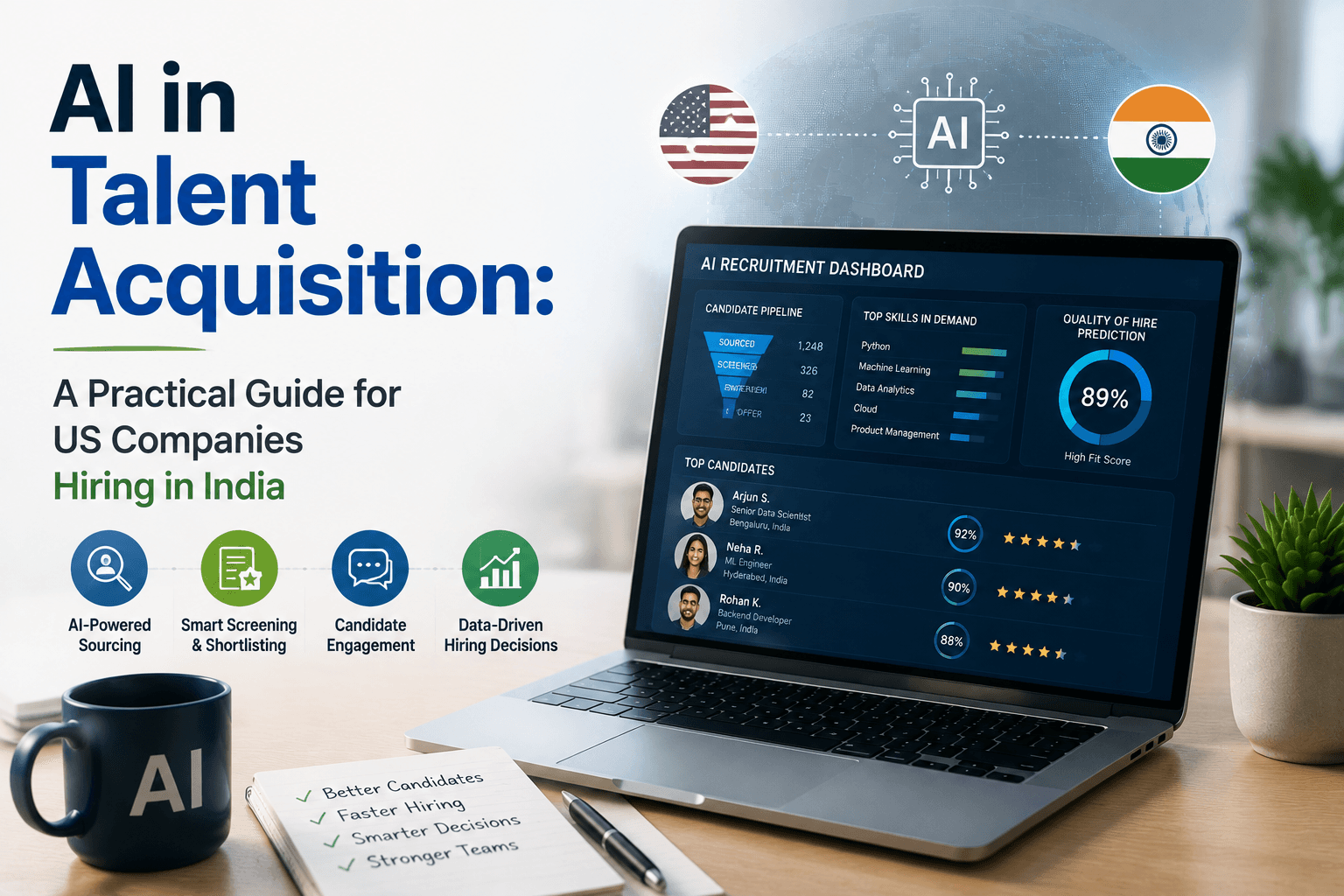
AI in Talent Acquisition: A Practical Guide for US Companies Hiring in India
Most US companies that use ai in talent acquisition domestically assume the same tools and processes transfer directly to India. Some do. Some do not. The ones that do not create a sourcing stack that looks efficient from a dashboard but produces thin pipelines, missed candidates, and slower time-to-offer than a recruiter working India-specific channels manually. This guide covers what ai in talent acquisition actually looks like when applied to India. AI in talent acquisition is the right fram

ByNilesh Parwani / August 26, 2026 / 12 min read
- What AI in Talent Acquisition Actually Does in an India Hiring Context
- Where US AI Recruitment Tools and AI in Recruitment Break Down in India
- AI Recruitment Tools That Actually Work for India Tech Hiring in 2026
- Building Your AI in Recruitment Stack for India AI Talent Specifically
- Frequently Asked Questions
- The Bottom Line
Most US companies that use ai in talent acquisition domestically assume the same tools and processes transfer directly to India. Some do. Some do not. The ones that do not create a sourcing stack that looks efficient from a dashboard but produces thin pipelines, missed candidates, and slower time-to-offer than a recruiter working India-specific channels manually.
This guide covers what ai in talent acquisition actually looks like when applied to India. AI in talent acquisition is the right framework for this problem, but it needs India-specific calibration to work. when the target market is India's AI engineering and technical workforce, which ai recruitment tools work for India specifically, where the US-to-India tool transfer breaks down, and how to build an ai in recruitment process that produces the right candidates at the right speed.
What AI in Talent Acquisition Actually Does in an India Hiring Context
Before evaluating any ai recruitment tools for India hiring, it helps to be precise about what ai in talent acquisition can and cannot do in 2026.
AI in talent acquisition automates five categories of hiring work , and understanding each one helps US companies build the right India stack:
Sourcing and candidate discovery. AI-powered platforms at the core of any ai in recruitment and ai in talent acquisition stack aggregate profiles from LinkedIn, GitHub, Naukri, job boards, and resume databases, then rank candidates by match against a defined role specification. This is where ai in recruitment and ai in talent acquisition deliver the most obvious time savings: surfacing a shortlist that would take a recruiter hours of manual search in minutes.
Resume and profile screening. AI recruitment tools use natural language processing to parse resumes, extract signals (skills, experience, company tier, role progression), and rank candidates against defined criteria. Platforms like Skillate (now part of SAP SuccessFactors) and TurboHire are specifically built for the India market and handle Indian resume formats, company tier classification, and college ranking signals that US-trained models often misread.
Interview scheduling and coordination. Scheduling is one of the highest-friction steps in India hiring for US companies operating across an 8.5 to 12.5 hour time zone difference. AI recruitment tools like Paradox and GoodTime automate scheduling coordination, candidate reminders, and calendar management across time zones. This is a category where ai in recruitment generates measurable time savings regardless of geography, and where ai in talent acquisition tools pay for themselves fastest.
Candidate assessment and pre-screening. AI in talent acquisition at this stage covers automated skills testing, video interview analysis, and conversational screening. In India, voice AI and conversational screening platforms account for 38% of enterprise AI hiring deployments in 2026 per Babblebots data. For high-volume IT and BPO roles, this ai in recruitment layer reduces first-round human screening load substantially.
Analytics and pipeline reporting. AI recruitment tools that track sourcing channel performance, time-to-hire by role and level, candidate drop-off rates, and diversity of pipeline give TA teams data they cannot easily generate from manual tracking. This is where ai in talent acquisition creates compounding value over time.
What ai in recruitment and ai in talent acquisition does not do: it does not replace human judgment on whether a candidate is the right fit for a specific team, product context, and working relationship. A ManpowerGroup 2026 study found that businesses had poor results when treating AI as a replacement for recruiter judgment rather than a tool that handles the repeatable parts of the process.
Where US AI Recruitment Tools and AI in Recruitment Break Down in India
The most common mistake in applying ai in talent acquisition and ai in recruitment to India hiring is importing a US tool stack without adjusting for India-specific context. Three categories of ai in recruitment and ai recruitment tools breakdown are predictable when US tools are applied to India hiring.
Resume format and signal mismatch.
Indian resumes are structured differently from US ones. Candidates in India frequently include their college tier, graduation year, and CGPA prominently. Companies in India are ranked by tier, and an AI recruitment tool trained on US hiring data will not reliably weight Infosys, Wipro, and TCS experience the same way an India-trained recruiter does. Some companies are prestigious feeder pools for product roles. Others are IT services firms where candidates learned COBOL-era processes. An ai in recruitment tool trained on US data that treats these the same produces a miscalibrated India shortlist every time.
India-built ai recruitment tools (Skillate, TurboHire, Keka, imocha) have been trained on India hiring data and handle these distinctions better than US-built tools adapted for India.
DPDP compliance.
India's Digital Personal Data Protection Act (DPDP) came into force in 2024 and imposes specific requirements on how candidate data is collected, stored, consented to, and transferred across borders. Any ai in talent acquisition or ai in recruitment stack processing India candidate data must handle DPDP compliance. US-built platforms frequently bolt DPDP compliance on as a premium tier rather than building it into the core product. India-built platforms tend to ship it in the standard product.
For US companies using US-headquartered ai recruitment tools to source and process India candidates, the data transfer and consent documentation requirements need to be verified explicitly before the tool goes live. An ai in recruitment process that creates a DPDP compliance gap generates legal exposure that offsets the efficiency gains.
Naukri integration and local job board coverage.
LinkedIn is the standard platform for US ai in talent acquisition sourcing. In India, Naukri.com is the largest job database with the deepest penetration for technical roles. Shine.com and Indeed India are secondary. Many US-built ai recruitment tools have limited or no native Naukri integration. A sourcing stack that does not cover Naukri is missing the highest-volume channel for India tech hiring.
Before deploying any ai recruitment tools for India sourcing, confirm its Naukri API integration status. Without it, the AI is sourcing from a subset of India's available candidate pool.
AI Recruitment Tools That Actually Work for India Tech Hiring in 2026
Based on India-specific deployment data and platform capabilities, these are the ai recruitment tools most relevant to US companies sourcing technical AI and software engineering talent in India.
For sourcing and discovery:
hireEZ is the most capable AI sourcing platform for cross-platform India candidate discovery. It aggregates across LinkedIn, GitHub, Stack Overflow, and Indian job boards, applies AI ranking, and supports outreach automation. For US companies without a dedicated India recruiting team, hireEZ is among the best ai recruitment tools for reducing manual search time.
SeekOut and Findem offer similar aggregation capabilities with strong India coverage and GitHub signal integration. Both are solid ai recruitment tools for finding AI engineers who are more visible on technical platforms than on Naukri.
For screening and assessment:
imocha is purpose-built for technical skills assessment in the India market. It covers coding tests, AI and ML skills assessments, and English communication screening in formats calibrated for India's hiring context. For US companies hiring AI engineers, imocha is one of the few ai recruitment tools that gives hiring managers standardized India-calibrated signal before a first interview. gives hiring managers standardized signal before a first interview.
Skillate (now embedded in SAP SuccessFactors) handles resume parsing and candidate matching with India-specific training data. For companies already on SAP SuccessFactors, it is the most integrated option. Outside that stack, TurboHire is among the more accessible India-built ai recruitment tools for screening and matching with similar India market calibration.
For scheduling and coordination:
Paradox handles interview scheduling automation across time zones with multilingual candidate communication. For US companies running India interviews across a 10.5 hour time zone offset, Paradox is one of the few ai recruitment tools that handles scheduling across this offset reliably that adds days to the hiring cycle.
For video interviewing and structured assessment:
HireVue is the most established AI video interviewing platform globally. Several major Indian IT services firms use HireVue for campus and lateral hiring. For US companies running structured AI-assisted first-round interviews with India candidates, HireVue provides consistent structure and ranked output.
InCruiter is one of the ai recruitment tools that handles technical interview execution for IT roles, useful for companies that want to outsource first-round technical screening to a structured AI-assisted process rather than running it internally.
For full-stack India TA operations:
Keka combines HRMS, payroll, and AI recruitment tools in one platform built for the India market. For companies that need an integrated ai in recruitment and ai in talent acquisition platform in India, Keka handles the full lifecycle from job posting through offer management, with DPDP compliance built in.
Building Your AI in Recruitment Stack for India AI Talent Specifically
General ai in talent acquisition tools solve general hiring problems. But ai in talent acquisition for AI engineers requires a more specific configuration than these ai recruitment tools provide by default. Hiring AI engineers, ML engineers, and AI product managers in India requires a more specific configuration.
Layer 1: Sourcing
For AI talent specifically, GitHub signal is as important as Naukri. Engineers who have built and shipped production AI systems leave a public record: repositories, contributions to open-source AI frameworks, documentation quality. AI recruitment tools that aggregate GitHub signals (SeekOut, hireEZ, Findem) give access to this signal. An ai in recruitment sourcing stack for India AI talent that relies only on Naukri and LinkedIn is missing the most reliable quality signal available.
Layer 2: Technical screening
AI in talent acquisition for technical roles requires a technical screen that goes beyond resume parsing. imocha or a custom coding assessment platform (HackerEarth, Codility) at the top of the funnel filters for demonstrated technical capability before first-round interviews. For AI roles specifically, the screen should include an exercise that requires production AI thinking: designing an evaluation framework, walking through a RAG architecture decision, or explaining how they handled model drift in a previous role.
Layer 3: Human judgment on production evidence
No ai in recruitment tool and no ai in talent acquisition platform currently replaces the judgment call on whether a candidate has the production experience that makes an AI engineer effective. The interview at this stage should be conducted by a technical person who can evaluate what the candidate has built, not just what they know. This is where the ManpowerGroup finding lands: AI in recruitment handles the volume, human judgment handles the fit. That is the correct division in any ai in talent acquisition process.
Layer 4: Employment and onboarding
AI in talent acquisition tools surface and qualify candidates. They do not resolve the employment structure question. For US companies without an India entity, every candidate who clears the process still needs to be employed through an EOR with a direct India entity. An ai in recruitment process that produces strong candidates but has no compliant employment structure ready at offer stage loses candidates who accept competing offers while the employment setup is being figured out.
Kaamwork combines talent sourcing with EOR employment in one platform, which eliminates the handoff gap. Candidate profiles arrive within 24 hours of a role kickoff. After offer acceptance, employment onboarding completes in 48 to 72 hours.
→ See how Kaamwork sources and employs India AI talent in one process: kaam.work/why-kaamwork/talent-centric-model
Talk to Kaamwork About AI Talent Acquisition in India URL placeholder: https://www.kaam.work/contact
Measuring What Your AI in Talent Acquisition and AI in Recruitment Stack Is Actually Doing
Most TA teams that deploy ai recruitment tools measure the wrong things. They track tool activity (resumes screened, messages sent, candidates shortlisted) rather than outcome quality (offer acceptance rate, first-year retention, production ramp time).
For ai in recruitment in India specifically, three metrics reveal whether the stack is working:
Interview-to-offer conversion rate, the most important ai in talent acquisition quality metric. If a significant percentage of India candidates who reach the interview stage do not receive or accept offers, the ai in talent acquisition sourcing is not calibrated correctly. Either it is surfacing candidates who look good on paper but lack production evidence, or the role is being misrepresented in outreach. A healthy India AI engineering interview-to-offer conversion rate runs at 50 to 70% for a well-calibrated sourcing process. Below 30% is a signal that the AI is optimizing for resume signals that do not predict interview performance.
Time from role kickoff to first interview, the ai in recruitment speed metric. This measures how quickly the ai in recruitment sourcing and screening layer, including ai in talent acquisition tools, produces qualified candidates. For India AI engineering roles, a well-configured ai in talent acquisition and ai in recruitment stack should produce first-round interviews within 5 to 10 business days of role kickoff. Longer than that usually means either the sourcing channel is not reaching the right segment, the outreach is low-response, or the screening layer is too conservative.
90-day retention, the ai in talent acquisition outcome metric. Candidates who leave within 90 days of joining are candidates the ai in talent acquisition process placed incorrectly. Good ai in recruitment metrics catch this pattern before it becomes a hiring pattern. Either the role was misrepresented, the candidate's production experience was overstated, or the team management model did not match what was described. AI recruitment tools cannot prevent this outcome, but the data identifies which sourcing channels and screening criteria are producing it.
Frequently Asked Questions
- What is AI in talent acquisition and how does ai in talent acquisition apply to India hiring specifically?
AI in talent acquisition refers to using artificial intelligence and machine learning. AI in talent acquisition covers candidate sourcing, resume screening, interview scheduling, assessment, and pipeline analytics. and machine learning to automate and improve parts of the hiring process: candidate sourcing, resume screening, interview scheduling, assessment, and pipeline analytics. When applied to India hiring for US companies, ai in talent acquisition requires tools that cover India-specific channels (Naukri, LinkedIn India), handle DPDP data compliance, and are calibrated for India resume formats and company tier signals. US-built ai in talent acquisition tools often need India-specific configuration or should be supplemented with India-built platforms. - What are the best ai recruitment tools for India tech hiring and ai in recruitment in 2026? When evaluating ai recruitment tools for India tech hiring, the strongest options by function are: hireEZ, SeekOut, or Findem for cross-platform sourcing including GitHub signals; imocha for technical skills assessment; TurboHire or Skillate (SAP SuccessFactors) for India-calibrated resume screening; Paradox for scheduling automation across time zones; HireVue for structured AI video interviewing; and Keka for full-stack India HRMS and recruitment operations. For AI talent specifically, supplementing ai in talent acquisition tools with GitHub portfolio review adds signal that automated platforms cannot replicate.
- How does ai in recruitment differ for AI engineering roles versus general tech roles, and which ai recruitment tools help?
AI in recruitment for AI engineering roles requires more emphasis on production evidence than for general tech roles. AI in recruitment processes optimized for general software engineering need recalibration for AI-specific hiring. than credential matching. Standard ai recruitment tools optimize for resume signals (years of experience, company tier, education level) that predict general software engineering performance but are weaker predictors for AI engineering roles, where production experience in specific domains (RAG systems, ML deployment, LLM evaluation) is the critical differentiator. An ai in recruitment process for AI engineers needs a technical screen that evaluates production evidence. No ai recruitment tools currently automate this judgment., not just Python and machine learning keyword matching. - What is DPDP and why does it matter for ai recruitment tools and ai in recruitment in India? DPDP (Digital Personal Data Protection Act) is India's data protection law. AI in recruitment platforms and ai recruitment tools processing India data must handle DPDP compliance., in force since 2024. It requires explicit candidate consent before collecting or processing personal data, restrictions on cross-border data transfers, and documented retention and deletion workflows. Any ai recruitment tools processing India candidate data must comply with DPDP. US-built ai in talent acquisition platforms often implement DPDP compliance as an add-on tier rather than a core feature. India-built platforms (Keka, TurboHire, Skillate) generally build DPDP compliance into the standard product. Verify DPDP handling explicitly before deploying any ai recruitment tool for India sourcing.
- How should ai in recruitment and ai in talent acquisition be integrated with EOR employment for India hiring? AI in recruitment handles sourcing, screening, scheduling, and assessment. AI in talent acquisition and ai in recruitment need to be synchronized with employment onboarding to avoid losing candidates between offer and start. EOR employment handles the legal employer relationship, payroll, statutory compliance, and onboarding in India. The two processes need to be synchronized: a strong ai in talent acquisition pipeline that produces candidates faster than the employment structure can onboard them creates offer-stage delays that lose candidates to competing offers. Platforms like Kaamwork integrate both functions, delivering sourced candidates and completing employment onboarding in 48 to 72 hours after offer acceptance.
The Bottom Line
AI in talent acquisition speeds up the volume-intensive parts of India hiring. AI in talent acquisition is the right framework, ai in recruitment is the day-to-day execution: surfacing candidates, screening resumes, scheduling interviews, and running assessments. Used correctly, ai in recruitment and ai in talent acquisition compresses time-to-first-interview from weeks to days and allows small US recruiting teams to run India hiring at a scale that was previously impossible without a dedicated India TA function.
The ai recruitment tools and ai in talent acquisition platforms that work best for India tech hiring are not always the same ones US teams use domestically. Naukri integration, DPDP compliance, and India-specific resume calibration are the three criteria that separate effective ai in talent acquisition from an ai recruitment tools stack that creates false efficiency that separate an ai in talent acquisition stack that delivers from one that creates a false sense of process efficiency while missing the candidates who matter.
The human judgment layer remains non-negotiable. AI in recruitment and ai recruitment tools handle the volume; technical interviews evaluate the production evidence; the EOR handles employment onboarding. All three need to be ready before the first offer goes out.
For US and UK companies building India AI teams with sourcing and employment compliance in one place: kaam.work
Start Hiring India AI Talent With Kaamwork URL placeholder: https://www.kaam.work/contact
Share this article

Founder & CEO | Kaam.Work
Nilesh Parwani, a Kelley School BBA graduate, worked at UBS and Warburg Pincus before founding PrintBell (acquired by Cimpress). In 2020, he launched kaam.work, a remote work platform focused on flexible talent and distributed teams.